MPB x Foam Talent Studio Visit: Ramona Jingru Wang
Studio Visit offers a look at the artistic practices, workspaces, and latest projects of contemporary photographers. For this collaboration with Europe's top camera reseller, MPB, Foam curators take a closer look at the practices of five 2026 Foam Talents. This time, Mirjam Kooiman dives into conversation with Ramona Jingru Wang.
When Ramona Jingru Wang appears on my screen for our online studio visit, she is sitting on her bed. There is a desk in the living room of her New York apartment, she tells me, but it is rather dark, so unless she needs it, her bedroom is often where she works.
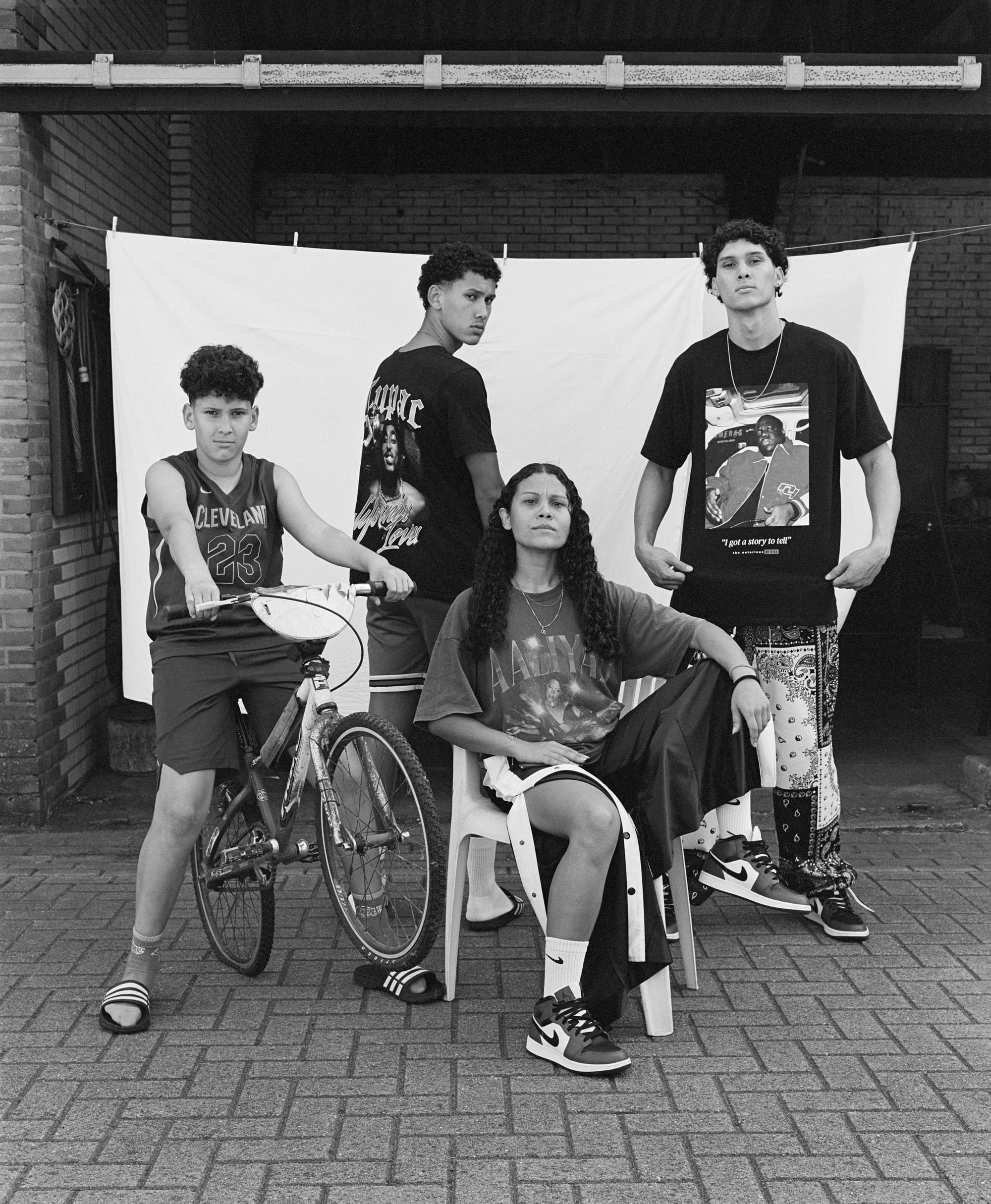
In a way, the bedroom might be as close to a studio as Wang needs. Her practice has no fixed address, but repeatedly takes shape in intimate spaces and through encounters with others. This feels fitting for a photographer ongoing project My Friends Are Cyborgs, But That’s Okay, for which she was selected as a Foam Talent 2026, grows out of conversations and collaborations with friends, whom she photographs in the environments they inhabit. So rather than asking what her studio looks like, our conversation begins with a different question: where does her work begin?
RJW: It started with my friends asking me to take portraits of them because they wanted to do modelling. They needed simple portraits for casting, and I would just do it in my room because all I needed was a wall. I didn’t really use those photos in the project, but that’s how I started thinking about it.
I also do modelling myself, and casting for commercials and fashion is really interesting. Sometimes they’ll say: ‘We want an Asian girl that looks Gen Z with pink hair’, and I’m like: that sounds like you’re describing a robot. They categorise you by your look. There’s even something called ‘real people casting’.
MK: Which is already a funny term – what does that say about models?
RJW: Exactly. They want young people who look cool, but also like they’re ‘real people'; they live near you, they’re your friends. The way they describe what they’re looking for made me think about the people I’m friends with, and how unique they actually are.
MK: I didn’t know you were modelling yourself. Would you say your autonomous practice is partly a response to that experience?
RJW: It’s not entirely a response to it, but it’s a starting point. When you’re shooting a commercial, the models aren’t really the subject. They’re there to present the product. I started thinking: what about the models? What’s their story? I want to dig deeper into every individual person, so they’re not just a type or a category.
It’s similar in sci-fi dystopian movies. There’s often a stereotypical Asian cyborg: sexualised, or robotic, smart and emotionless, serving the main character. I’m interested in how Asian bodies and faces are used to serve something else – a product in a commercial, or a narrative in a movie.
MK: How do you move beyond that type when you photograph someone yourself?
RJW: It’s different for everyone. I tell them briefly what the project is about: it’s like a mockumentary – imagine you’re a cyborg; how do you present your life? How do you want to show it?
They tell me what they’re interested in, how they live, where they usually go. Sometimes they’re like, ‘I work in bed,’ so I’m like, okay, then we’ll shoot you in bed. I think of it as creating an event. You create a situation and people start doing things within it. I might bring props, and we think of specific poses, but they’re aligned with how people see themselves.
MK: You’ve described photography as a form of care. What does that look like in your practice?
RJW: I need to make sure this is how they want to be presented in the photograph – that it aligns with who they are. Maybe sometimes it’s exaggerated, but it’s an imagination of how they want to be in the photo. I think that’s a way of caring.
Photography makes me more observant too. The better photos are often the ones after the photo you planned to take, when people relax. But I also think: would I want to look like that in a photo? It’s an empathetic practice. You have to feel it out.
MK: Where do you think that comes from?
RJW: When I was a kid, my mom took a lot of photos of me just doing things, so I’m really comfortable with that. And when I look at my photos now, I see the similarity. Even when we’re just hanging out, my friends know that I’m going to be taking photos at some point.
MK: And that seems to blur the boundary between your personal and commissioned work as well.
RJW: Sometimes people hire me and say: we want you to shoot your friends, just however you always do. Those are the best jobs.
I recently did a campaign for a camera brand. Every year I go on a trip upstate with my friends, and I suggested photographing that trip. I used iPhone photos from our previous trips to show the brand what it could look like. We were going to swim, visit a farm, go grocery shopping and cook breakfast – only this time, those everyday moments would also become the shoot, just with a better camera.
MK: Speaking of which…what camera do you usually use?
RJW: Apart from sometimes shooting digitally for commissioned work, I mostly use a medium-format film camera. It requires me to work more slowly and deliberately, but it also emphasises the process: both the model and I know that we’re creating an image together.
When I’m hanging out with friends, I’ll just shoot with my phone, but I’ve never really presented those photos as my work. I think of them more like research. They stay in the back of my mind.
MK: Looking ahead, is there a question photography hasn’t answered for you yet?
RJW: That’s so big! I think I’ll probably work this way forever because that’s just how my personality is. It’s more: how far can I take this?
In commercial work, I keep thinking about how you can bring more humanity into a photograph when the person in it is ultimately there to sell a product. But I think that question extends beyond commercial photography. Whether it’s advertising, journalism or documentary photography, how do you photograph someone without reducing them to a type, a function, or a story you want them to represent? How do you retain that humanity, that genuine aspect of a photograph? I don’t think I can fix that, but I’m doing my part.
This Studio Visit is made in collaboration with MPB.
About the artist
RAMONA JINGRU WANG is a lens-based artist based on the internet and New York. Her work explores how images intervene with our reality and create connections among people and space, investigating how we care for each other through photographs. She was the recipient of the Magnum Foundation New York City Fellowship 2026, and her work has been exhibited in the Museum of the City of New York.
About the author
MIRJAM KOOIMAN is a curator, art historian and essayist. At Foam, she has curated over 45 exhibitions, including The Camera as a Weapon and Missing Mirror: Photography Through the Lens of AI, and written more than 50 essays and editorial texts for exhibitions, magazines, catalogues and artist books. She has initiated international curatorial exchanges with photography platforms in Mexico, Nigeria and Indonesia, and is co-founder of the Dutch art platform De Kunstmeisjes, with which she has co-authored two books on art history.
About MPB
MPB empowers creators to tell their stories by making pre-owned photo and video equipment more accessible. Whether buying a first camera, upgrading a kit, or giving used gear a second life, MPB makes it easy to buy, sell, and trade equipment. Through its collaboration with Foam Talent 2026, MPB supports the next generation of image-makers, helping emerging photographers share their work with audiences around the world and opening up new creative possibilities.